 EN
EN
The Real Cost of Counterfeits No One Talks About
Fake products do not just nibble at the edges of a revenue report. They hollow out a brand from the inside, often in ways that never make it to a P&L spreadsheet. A shipment of counterfeit phone chargers that overheats and burns a nightstand, for example, generates a customer service nightmare and a wave of one-star reviews that cling to the brand for years. The damage sits at the intersection of liability, reputation erosion, and a quiet loss of channel partner confidence.
There is also the data side. The OECD and the EU Intellectual Property Office have repeatedly pegged global trade in counterfeit goods at over 3% of world trade, and the number keeps climbing. For a brand with $200 million in annual revenue, a conservative 5% revenue leakage from fakes means $10 million missing from the top line, not counting the legal and support costs that follow. The real sting is that every fake sold is a lost opportunity to build a relationship with a real customer. That customer might never know they bought a knockoff, but they will definitely remember the shoddy experience.
How an Anti Counterfeit Solution Actually Works: Layered Defense
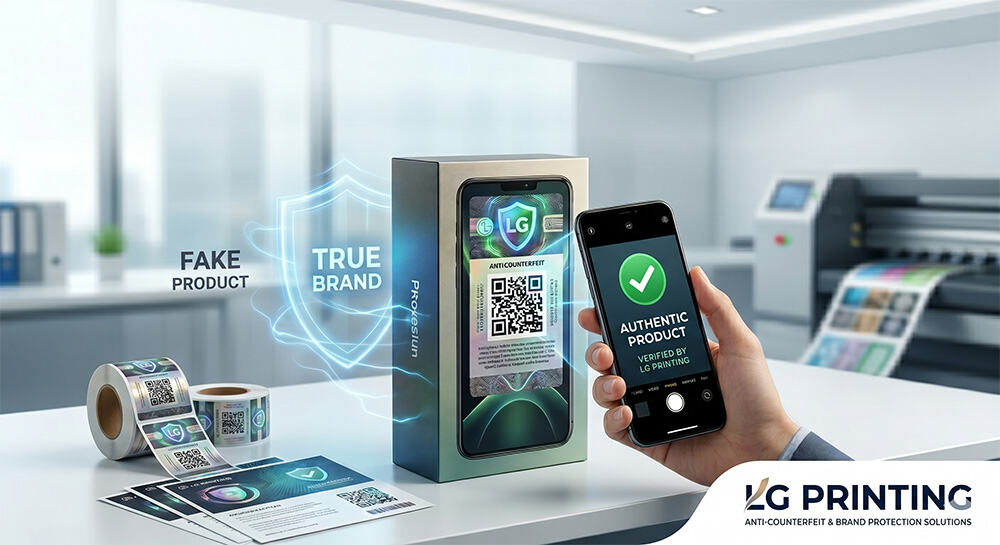
A solid anti counterfeit solution rarely relies on a single magic feature. The most effective systems are built in layers, combining overt, covert, and digital forensic elements. Overt features, like a high-end hologram sticker that shifts color and pattern when tilted, give consumers and customs officers a quick visual check. Covert markers, invisible to the naked eye and readable only with a specific handheld scanner or UV light, serve as a second line of defense for field investigators and brand protection teams.
Behind those physical layers sits a digital backbone. Unique serialized identifiers, often a QR code or an alphanumeric string, tie each product unit to a cloud-based record. When the code is scanned, the system can return not just a “genuine” or “fake” result, but also product origin, batch number, and even an interactive brand experience. This layered approach makes it dramatically harder for counterfeiters to replicate the full set of protections, because the cost and complexity jump exponentially with each added layer.
Holograms, QR Codes, and Digital Twins: Choosing the Right Mix
There is no one-size-fits-all stack. The right combination depends on the product category, distribution channels, and the sophistication of the counterfeiting threat. The table below gives a snapshot of how common elements compare in a field deployment context.
| Feature | Consumer-Facing Verification | Replication Difficulty | Typical Cost per Unit | Best Use Scenario |
|---|---|---|---|---|
| 3D Security Hologram | High (visual, intuitive) | Very High | Medium | Premium consumer goods, pharma cartons |
| Serialized QR Code | High (smartphone scan) | Medium (code can be copied if not digitally secured) | Low | Consumer electronics, apparel, food |
| Covert UV Marker | None (requires tool) | High (invisible, specialized) | Low | Field audits, law enforcement support |
| Digital Twin (Blockchain-linked) | Medium-High (via app) | Very High | Medium-High | Luxury goods, high-value industrial parts |
Picking just a QR code without a secure physical anchor, for instance, leaves a gap. A counterfeiter can copy a valid code and paste it onto a thousand fake units. But when that QR code is paired with a 3D hologram that is nearly impossible to replicate accurately, the window for fraud shrinks considerably.
A Live Case: When a Mid-Sized Electronics Brand Fought Back
A couple of years back, a consumer audio brand started noticing a strange pattern in their Southeast Asia returns. Customers were sending back earbuds that looked genuine on the outside but had wildly inconsistent battery life and poor solder joints inside. The packaging was good enough to fool even some of the brand's own frontline support staff. After a market sweep, the brand's regional team found a small warehouse in Bangkok where thousands of units were being repackaged with near-perfect copies of the outer box.
The turnaround came when the brand deployed a layered anti counterfeit solution. They shifted from a generic holographic seal to a custom 3D hologram sticker with a micro-engraved serial code, and paired it with a tamper-evident security label on the inner tray. Each serial was linked to a mobile-friendly verification page that logged the scan location and timestamp. Within four months of the rollout, verified scan rates tripled, and most importantly, the number of confirmed fake returns traced back to unauthorized sellers dropped by over 70%. The real win was invisible: the local distributor network, which had been losing trust, started pushing the product hard again because they knew counterfeits would be caught.
Building Consumer Trust with Visible and Invisible Markers
Trust is not built by a label that says "100% genuine." It is built by giving consumers and partners a simple, repeatable verification habit. An overt feature like a high-end security hologram sticker acts as a trust anchor on the shelf. But the invisible markers, a UV-responsive ink or a microscopic taggant added to the adhesive layer, back up the brand's promise when things get serious, like a customs seizure or a legal dispute.
Some brand owners hesitate to invest in covert features because "the customer never sees them." That misses the point. Covert features are the safety net that catches what overt features miss. If a counterfeiter manages to produce a decent-looking hologram, the absence of the covert marker is what a trained investigator uses to shut down a criminal operation. Together, the visible and invisible form a full-circle proof system.
Why Supply Chain Visibility Is the Real Game Changer
The quiet revolution in anti counterfeit solution design is not in the sticker itself, but in the data trail it generates. When every scan, from the factory floor to the end consumer, feeds into a secure platform, brand owners get a near real-time map of where products are moving, where diversion is happening, and where gray market activity is clustering. This supply chain visibility transforms brand protection from a reactive cost center into a strategic intelligence asset.
It also changes the economics of enforcement. Instead of relying solely on periodic raid-and-seizure actions, a brand can spot anomalies, like a sudden spike of scans in a region where no product has been officially shipped, and trigger a targeted investigation early. That kind of early-warning capability rarely comes from traditional track-and-trace alone. It comes from integrating physical security labels with a smart digital backend, precisely the kind of hybrid system that modern manufacturers are now scaling.
For brands evaluating a next move, working with a manufacturer that has deep expertise in 3D hologram technology and a robust production line for security labels and packaging makes the transition smoother. OPOC, for instance, focuses on precisely that intersection, producing security hologram stickers, self-adhesive labels, and security package boxes under one quality-controlled roof. That tight integration helps avoid the finger-pointing that can happen when labels come from one supplier and packaging from another, and it gives brand protection teams a single, accountable origin for the physical layer of their defense.
Table of Contents
- The Real Cost of Counterfeits No One Talks About
- How an Anti Counterfeit Solution Actually Works: Layered Defense
- Holograms, QR Codes, and Digital Twins: Choosing the Right Mix
- A Live Case: When a Mid-Sized Electronics Brand Fought Back
- Building Consumer Trust with Visible and Invisible Markers
- Why Supply Chain Visibility Is the Real Game Changer