 EN
EN
When a Product Tells Its Own Story
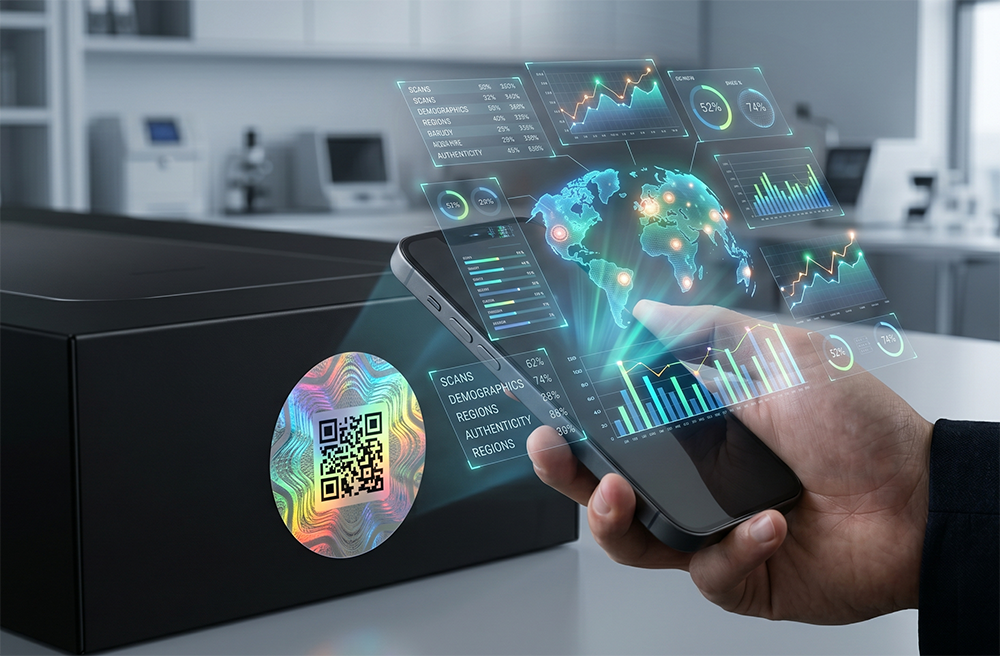
A lot of brand managers still think of a QR code as a shortcut to a landing page. That was true ten years ago. What has changed is the data layer sitting behind that scan. Every tap now carries a timestamp, a geolocation fingerprint, a device signature, and a session trail that can be cross-referenced against a product's entire distribution history. That shift turns a simple printed pattern into a live sensor network spread across every shelf, warehouse, and consumer's hand.
Why Guessing at Supply Chain Visibility Costs More Than It Saves
The default mode for mid-market brands is still reactive. A distributor in one region reports stockouts while another sits on three months of inventory and no one connects the dots until the quarterly review. qr code tracking changes that arithmetic because the data arrives in hours, not quarters. A brand team can spot a regional inventory imbalance while there is still time to reroute a shipment rather than mark it down later. That kind of responsiveness is not about technology for its own sake, it is about preserving margin that leaks away silently when decisions run on stale information.
The Anatomy of a QR Code Tracking Data Stream
When a label carrying a serialized QR moves through a supply chain, each scan point generates a structured event. The minimum viable data fields look something like this:
| Data Field | What It Captures | Why It Matters |
|---|---|---|
| Timestamp | Exact UTC moment of scan | Detects dwell time and bottlenecks |
| Geo-coordinates | Scan location (warehouse, store, consumer) | Maps gray market diversion |
| Device type | Scanner gun vs. consumer smartphone | Separates logistics from engagement |
| Product batch | Manufacturing lot and date code | Enables targeted recalls |
| Authentication status | Pass / fail / flagged | Blocks counterfeits in real time |
| Scan frequency | First-time vs. repeat scan count | Identifies resale or tampering patterns |
This granularity is what separates a modern track and trace approach from old-school barcode counting. A single scan event is trivia; a pattern of scan events over thirty days across twelve provinces is market intelligence.
What Real-Time Visibility Actually Looks Like on the Ground
A mid-size cosmetics brand in Southeast Asia adopted serialized QR labels across its premium skincare line in late 2024. The initial motivation was straightforward: unauthorized online resellers were undercutting authorized retail partners by 25 to 30 percent, and the brand had no mechanism to trace which distributor was leaking. Within six weeks of deployment, scan data from e-commerce return addresses and consumer verification scans flagged a cluster of units all originating from a single wholesale partner in Ho Chi Minh City. The brand terminated that relationship, redirected the volume to a compliant distributor, and recovered roughly $180,000 in annual channel margin. That is not a hypothetical, it is what happens when location data meets serialization at scale.
How Consumer Engagement Data Closes the Feedback Loop
There is a second payoff that brands often discover by accident. When a customer scans a QR code to verify authenticity, the brand receives a clean signal: this person has the product in hand, at a known location, and cared enough to check. That is worth more than a thousand retargeting impressions. Over time, scan geography and frequency data reveal which markets have the strongest organic demand, which retail partners drive the most verification traffic, and which product batches generate the highest re-scan rates, a useful proxy for repurchase intent. According to GS1's 2025 global survey on supply chain digitization, 64 percent of brand owners who implemented serialized product identification reported measurable improvement in demand forecasting accuracy within twelve months.
Getting the Infrastructure Right Without Overcomplicating It
The technical stack does not have to be overwhelming. At minimum, a brand needs three components: serialized QR labels with secure variable data printing, a cloud-based scan event database with a clean API, and a consumer-facing verification interface, typically a mobile web page or a lightweight mini-program. The labels need to survive the product's lifecycle conditions, humidity for beverages, abrasion for logistics cartons, none of which is trivial but all of which is solvable with the right material science. What trips up most deployments is not the physical label but the integration logic between the scan database and the existing ERP. A batch of 50,000 labels is a procurement exercise; making those 50,000 scan events talk to a legacy order management system is a data engineering exercise.
OPOC brings practical depth to this space, with in-house label manufacturing and serialization capabilities that eliminate the split-responsibility headache brands often face when sourcing labels from one vendor and software from another. Having the physical tag and the digital backbone under one roof reduces the finger-pointing that typically drags out deployment timelines.
Table of Contents
- When a Product Tells Its Own Story
- Why Guessing at Supply Chain Visibility Costs More Than It Saves
- The Anatomy of a QR Code Tracking Data Stream
- What Real-Time Visibility Actually Looks Like on the Ground
- How Consumer Engagement Data Closes the Feedback Loop
- Getting the Infrastructure Right Without Overcomplicating It