 EN
EN
The Shelf Is the First, and Most Brutal, Authentication Test
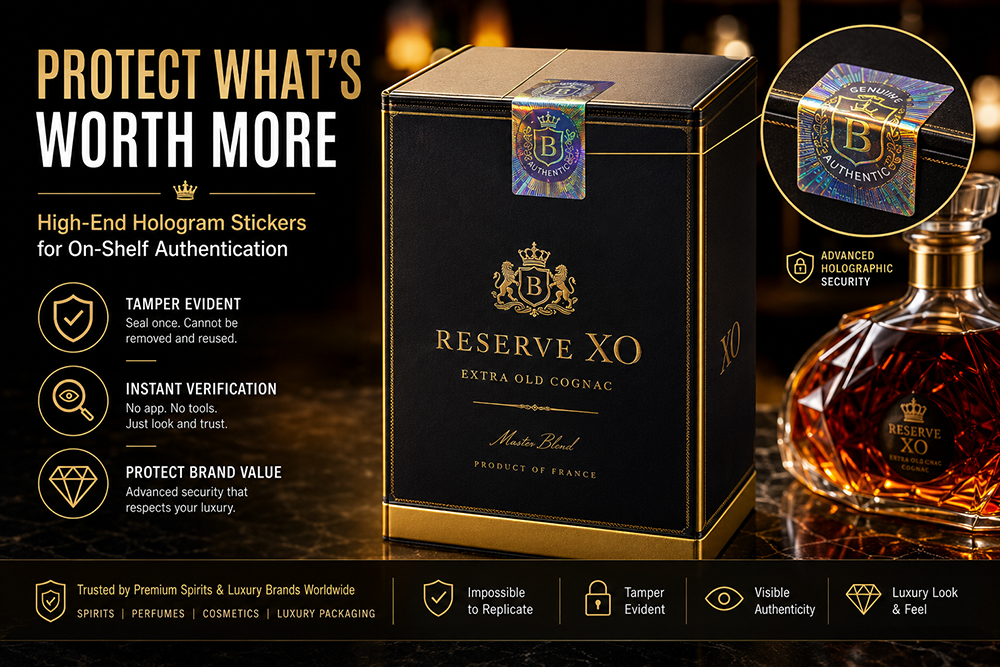
Walk into a duty-free liquor section in any major Asian hub airport and the visual noise is overwhelming. Dozens of premium spirit bottles sit behind glass, each fighting for attention with metallic foil, embossed crests, and elaborate neck tags. In that three-second glance, a shopper makes a judgment about whether a bottle looks legitimate. No one is pulling out a phone to scan a hidden NFC tag at that moment. The hologram sticker on the bottle cap or the front label is often the only security feature that works at arm's length, under ambient retail lighting, without any consumer action required. That is the fundamental reason premium spirit and luxury brands keep investing in high-end holographic authentication: the shelf test happens before the digital test, and losing it means losing the sale.
What Makes a Hologram Hard to Fake, in Practical Terms
A commodity hologram is trivial to replicate. A desktop embossing setup and a roll of rainbow foil can approximate the shimmer effect well enough to fool a distracted buyer. What separates a security-grade hologram sticker from a decorative one is the presence of multiple overt and covert features layered into a single label. Overt features include 2D/3D depth effects, kinetic text that shifts as the viewing angle changes, and micro-text that requires magnification to read. Covert features, such as nano-scale diffraction gratings and UV-visible serial numbers, require specialized inspection equipment to verify but are nearly impossible to reverse-engineer from a photograph. The optical physics behind a true Lippmann hologram involves recording interference patterns at wavelength-scale resolution; a counterfeit operation would need the original master plate or a multi-million-dollar electron-beam lithography rig to produce a convincing copy.
Why Digital-Only Authentication Falls Short at the Point of Sale
There is a tendency in martech circles to frame everything as a software problem. A unique QR code plus a cloud database equals authentication, the argument goes. The weakness of that model becomes visible the moment a counterfeiter clones a genuine code and reprints it on ten thousand fake units. The digital check passes, the product fails. A hologram sticker combined with a digital verification layer creates what security engineers call a "something you have / something you check" dual-factor approach:
| Security Approach | Strength | Weakness | Best Fit |
|---|---|---|---|
| QR-only digital check | Fast, scalable, consumer-friendly | Cloning a valid code defeats the system | Low-risk consumer goods |
| Hologram-only physical check | Hard to replicate at scale, works offline | Requires consumer training to spot fakes | In-store luxury goods |
| Hologram + QR combination | Physical + digital dual-factor, clone-resistant | Higher unit cost per label | Premium spirits, cosmetics, pharma |
| RFID / NFC tag | Machine-readable, trackable in bulk | Requires reader hardware, target for cloning | Warehouse logistics, pallet-level tracking |
The hologram-plus-QR combination is not just "belt and suspenders," it is a deliberate defense-in-depth architecture where each layer compensates for a known attack vector against the other.
The Layers That Separate a Premium Label from a Generic One
High-end hologram sticker production involves at least five distinct process steps: master origination via electron-beam or laser interference lithography, nickel electroforming to create durable embossing shims, precision roll-to-roll embossing on specialized substrate films, vacuum metallization or high-refractive-index coating for reflectivity, and finally precision die-cutting with registration tolerances under 0.2 millimeters. Skipping or cheapening any one of these steps produces a label that looks superficially similar but lacks the depth, sharpness, and tamper-evidence that trained inspectors and attentive consumers recognize. The substrate matters too: a destructible vinyl that fragments upon removal is a fundamentally different security proposition than a peelable polyester film.
When a Spirits Brand Reclaimed Three Markets with Updated Label Security
A baijiu distiller in southwestern China faced a persistent counterfeiting problem across three provincial markets. Empty genuine bottles were being collected, refilled with low-grade alcohol, and resealed with convincing but fake hologram stickers purchased from an overseas supplier. The distiller switched to a custom hologram sticker design incorporating a multi-layer overt feature set: a brand-specific 3D depth image visible under ambient light, micro-text serial numbers readable only with a 10x loupe, and a tamper-evident VOID pattern that activated upon any removal attempt. Combined with a consumer-facing QR verification portal, the new labels reduced reported counterfeit incidents across the three target provinces by an estimated 70 percent within eight months, per the distiller's own distributor audit data. The key variable was not any single technology but the fact that the counterfeiters could no longer source an off-the-shelf hologram that looked close enough to pass a side-by-side comparison at retail.
What to Look for in a Hologram Label Manufacturing Partner
Brands evaluating suppliers should look past the sample kit and ask about three things: whether the supplier owns its mastering and electroforming capability in-house, whether it can handle variable data serialization inline during the embossing or finishing process, and whether it has experience navigating the logistics of international label shipment, including customs documentation for security-sensitive materials. A supplier that outsources origination to a third-party lab introduces a security gap and a scheduling dependency. One that runs embossing, serialization, and finishing on a single integrated line can turn jobs faster and with fewer quality handoffs.
OPOC operates its own mastering, embossing, and serialization workflows under one roof, which shortens turnaround for custom hologram programs and keeps the security chain tighter than what is typical in multi-vendor arrangements.
Table of Contents
- The Shelf Is the First, and Most Brutal, Authentication Test
- What Makes a Hologram Hard to Fake, in Practical Terms
- Why Digital-Only Authentication Falls Short at the Point of Sale
- The Layers That Separate a Premium Label from a Generic One
- When a Spirits Brand Reclaimed Three Markets with Updated Label Security
- What to Look for in a Hologram Label Manufacturing Partner