 EN
EN
Track and Trace Is Not a Logistics Tool, It Is a Data Engine
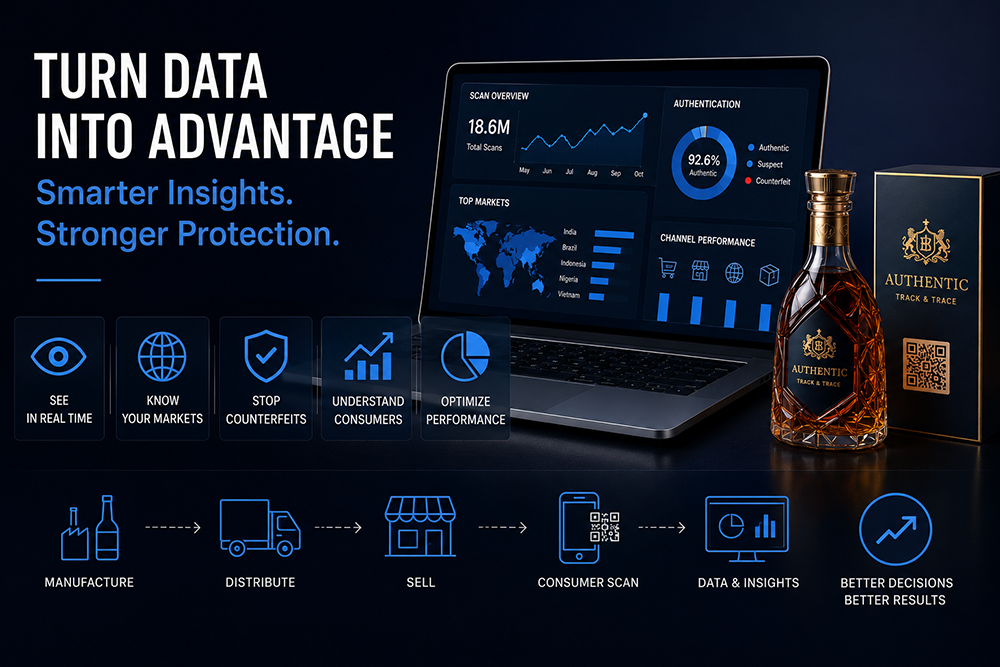
The phrase "track and trace system" still conjures images of warehouse scanners and pallet labels for a lot of people. That perception is about five years out of date. A modern track and trace system generates a continuous data exhaust from every node in the supply chain: manufacturing, warehousing, distributor handoffs, retail placement, and end-consumer verification. The question is not whether the data exists, it is whether the analytics layer can turn raw scan logs into decisions that affect pricing, channel strategy, production planning, and brand protection enforcement. A dashboard that shows a green checkmark next to "shipment delivered" is table stakes. What separates a strategic deployment from a compliance checkbox is whether the system can answer questions the brand team has not thought to ask yet.
The Difference Between Storing Scan Events and Understanding Them
Every track and trace system captures scan events by default. A barcode gets read at the factory gate, another scan at the distributor's receiving dock, another at the retail point of sale. Storing those records is the easy part. The analytics challenge lies in pattern recognition across time and geography. A system that cannot distinguish between a legitimate restocking scan and an anomalous third-shift warehouse scan followed by a spike in e-commerce discount listings is just a digital filing cabinet. The capability gap shows up in three areas: anomaly detection that flags statistically improbable scan sequences, geospatial clustering that identifies unauthorized distribution hotspots, and temporal analysis that reveals dwell-time patterns indicating counterfeit insertion windows in the logistics chain.
Five Analytics Capabilities That Separate Basic Systems from Strategic Ones
When brand owners evaluate track and trace platforms, the feature list tends to be long and jargon-heavy. Stripped down to what actually matters for decision-making, there are five analytics capabilities worth prioritizing:
| Analytics Capability | Basic System (Compliance-Focused) | Strategic System (Decision-Focused) |
|---|---|---|
| Scan event visualization | Static map with pin drops | Heatmap with time-slider and anomaly highlighting |
| Gray market detection | Manual report generation | Automated geo-anomaly alerts with distributor-level attribution |
| Consumer engagement analytics | Scan count per month | Scan-to-purchase correlation, re-scan rate by SKU, user journey mapping |
| Recall response modeling | Batch number lookup | Real-time affected-unit geolocation with notification radius estimation |
| Predictive inventory redistribution | Historical sales averages | Machine-learning demand signals from serialized scan velocity across regions |
The systems that deliver on the right-hand column share one architectural trait: they treat every scan event as a row in a time-series database, not as a document in a flat log. That distinction matters enormously when the analytics engine needs to run aggregations across millions of events in under three seconds to surface an alert.
When Supply Chain Data Collides with Consumer Behavior Data
There is a crossover point that mature deployments consistently hit around the eighteen-month mark. By then, the system has accumulated enough consumer verification scans, those are end-user scans through a brand's authentication portal, to correlate distribution patterns with actual purchase behavior. A brand might discover that a distributor consistently reporting strong sell-through actually has the lowest consumer scan rate in the network, suggesting that reported volumes are going somewhere other than to end consumers. Or it might find that a particular retail chain drives verification scans at three times the rate of comparable outlets, a signal worth investigating for partnership expansion. These insights are not available from sell-in data alone. They require the integration of serialized supply chain scans with authenticated consumer interaction data, which is precisely where a unified track and trace system earns its keep beyond compliance.
A Pharmaceutical Serialization Deployment That Changed the Conversation
A Southeast Asian pharmaceutical manufacturer deployed serialized track and trace across its over-the-counter product lines to meet updated ASEAN regulatory requirements. The initial goal was compliance: every unit needed a unique identifier traceable from factory to pharmacy. About nine months into the deployment, the analytics team noticed an unusual pattern: scan events for a popular analgesic product were clustering in a province where the company had no authorized wholesale partner. Further analysis revealed that a licensed distributor in a neighboring province was diverting approximately 12 percent of its allocated volume to unregistered pharmacies across the border. The manufacturer restructured its distribution agreements in that region, introduced geo-fenced scan verification at the wholesale level, and reduced unauthorized channel leakage by an estimated 60 percent within the following two quarters. The compliance mandate paid for the system; the analytics capability turned it into a profit protection tool.
What the Analytics Stack Needs to Look Like Going Forward
The next twelve to twenty-four months will push track and trace analytics toward three converging trends. First, the integration of serialized product data with retail point-of-sale feeds will close the loop between shipment and consumption, enabling near-real-time sell-through visibility that currently requires manual reconciliation. Second, machine learning models trained on historical scan patterns will begin surfacing predictive risk scores for specific distribution lanes, flagging potential diversion before it happens rather than after. Third, regulatory frameworks in markets such as the EU, under the Falsified Medicines Directive model, and in multiple Southeast Asian nations are expanding serialization mandates beyond pharmaceuticals into cosmetics, food supplements, and high-value consumer packaged goods. Brands that build the analytics capability now will be ahead of the compliance curve rather than scrambling to catch up.
OPOC manufactures serialized track and trace labels with inline variable data integration, which gives brand owners a single-source starting point for building out their analytics infrastructure without stitching together multiple label and software vendors.
Table of Contents
- Track and Trace Is Not a Logistics Tool, It Is a Data Engine
- The Difference Between Storing Scan Events and Understanding Them
- Five Analytics Capabilities That Separate Basic Systems from Strategic Ones
- When Supply Chain Data Collides with Consumer Behavior Data
- A Pharmaceutical Serialization Deployment That Changed the Conversation
- What the Analytics Stack Needs to Look Like Going Forward