 EN
EN
The Physical-Digital Divide Is Where Brand Control Slips
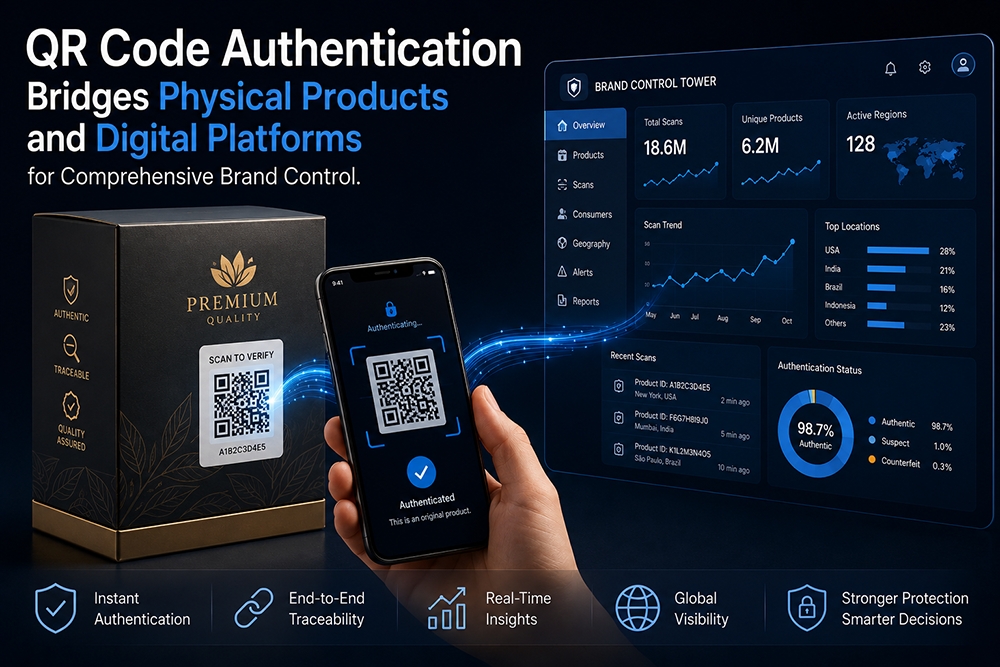
Every physical product that leaves a factory enters a blackout period from the brand's perspective. Until that unit is purchased and, if the brand is lucky, registered or reviewed, there is no signal linking the manufactured item to an actual end user. The gap between production and consumption is where counterfeits get inserted, gray market diversion goes undetected, and warranty fraud accumulates. qr code authentication closes that gap by turning every product into a node on the brand's own digital network. The moment a consumer, retailer, or customs officer scans the code, the product transitions from anonymous inventory to an authenticated asset with a verifiable chain of custody. That transition is not a marketing gimmick, it is a structural shift in how brand control operates across physical and digital domains.
Authentication That Goes Beyond "Genuine or Fake"
A binary yes/no authentication result is the minimum viable output, but it is also the least interesting. The real value of a qr code authentication system emerges when the scan result carries contextual intelligence. A code linked to a specific production batch can tell a retailer whether the unit is still within its authorized sales window. A code tied to a distribution route can flag whether the product has appeared in a geography where no legitimate shipment was recorded. A code associated with a consumer engagement history can surface whether this is a first-time verification, a repeat check by a suspicious buyer, or a scan that has already been queried from multiple locations in different countries within hours, a classic indicator of code cloning. The authentication event stops being a gatekeeper function and starts acting as an early warning system.
The Technical Stack Behind a QR Code Authentication Program
The physical-to-digital bridge rests on three technical pillars: the printed identifier, the secure verification backend, and the consumer-facing interface. Each pillar has design choices that affect both security posture and user experience:
| Component | Key Design Decisions | Security Considerations |
|---|---|---|
| Printed QR label | Substrate durability, variable data encoding, tamper-evident adhesive | Label must survive its environment; adhesive must leave forensic evidence on removal |
| Serialization engine | Random vs. sequential numbering, encryption of payload, batch-to-cloud sync | Predictable serial numbers enable pre-computed cloning; encrypted payloads resist brute-force enumeration |
| Verification backend | Cloud vs. on-premise hosting, API architecture, rate limiting per IP/device | Rate limiting blocks mass-validation attacks; geo-anomaly rules catch cloned codes |
| Consumer interface | Mobile web vs. native app vs. mini-program, load time under 2 seconds | Friction kills adoption; faster verification equals higher scan rates |
| Analytics pipeline | Real-time vs. batch processing, integration with CRM and ERP | Real-time alerts catch active fraud; batch analysis reveals slow-burn patterns |
The interdependence of these layers means that a weakness in any one component, a label that peels cleanly, a serial number scheme that can be guessed, a mobile page that times out, degrades the entire system. Security is only as strong as the weakest link, and in qr code authentication, the weakest link is almost always the physical label rather than the software.
What Happens When Authentication Data Feeds a Brand's CRM
There is a quiet revolution happening in how consumer goods brands think about first-party data. For years, brands sold through retail channels had almost no direct relationship with end buyers. A qr code authentication scan changes that, because the verification action is a zero-party data event: the consumer voluntarily initiates contact with the brand, motivated by a desire to confirm product authenticity. That intent signal is fundamentally different from a retargeting pixel or a purchased email list. Brands that connect their authentication backend to their CRM can build opted-in consumer profiles anchored to verified purchase events, not inferred browsing behavior. The downstream applications include personalized replenishment reminders tied to actual consumption cycles, loyalty rewards triggered by repeat verification, and geographic demand heatmaps that inform retail expansion strategy.
A Consumer Electronics Brand Learned About Code Cloning the Hard Way
A fast-growing consumer electronics brand launched a QR-based product registration and authentication program for its wireless earbud line. The initial implementation used sequential alphanumeric codes printed on the outer packaging with a standard paper label. Within four months, the brand's customer service team began receiving complaints from buyers who scanned their code only to see a message stating the product had already been registered. Investigation revealed that a counterfeiting operation in a southern Chinese manufacturing hub had purchased a single genuine unit from each production batch, extracted the QR code pattern, and used a printing service to reproduce that same code on thousands of counterfeit boxes. Because the serial numbers were sequential and the labels offered no tamper evidence, there was no way to distinguish a genuine scan from a cloned one. The brand subsequently migrated to cryptographically signed QR codes printed on destructible tamper-evident substrates, paired with a backend that flagged rapid multi-geography scans of the same identifier. Cloned-code complaints dropped to near zero within sixty days. The lesson was expensive but clear: the label material and the serialization logic are authentication features, not just packaging details.
What Makes Authentication Infrastructure Future-Proof
Three design principles separate authentication programs that scale from those that require a rebuild every two years. The first is format-agnostic identifier architecture: the system should treat a QR code, an NFC tag, and a alphanumeric serial string as interchangeable carriers of the same authenticated payload, so that adding a new label technology does not require re-architecting the backend. The second is API-first integration design that allows the authentication database to feed data into CRM, ERP, and supply chain management platforms without custom middleware for each connection. The third is cryptographic agility, meaning the ability to rotate signing algorithms as computational standards evolve, without invalidating already-deployed product labels still circulating in the market.
OPOC prints security-grade QR labels with encrypted variable data on tamper-evident substrates, and the in-house serialization infrastructure supports the kind of API-ready authentication architecture that brand owners need to connect physical products to their digital ecosystems without fragmentation.
Table of Contents
- The Physical-Digital Divide Is Where Brand Control Slips
- Authentication That Goes Beyond "Genuine or Fake"
- The Technical Stack Behind a QR Code Authentication Program
- What Happens When Authentication Data Feeds a Brand's CRM
- A Consumer Electronics Brand Learned About Code Cloning the Hard Way
- What Makes Authentication Infrastructure Future-Proof