 EN
EN
Optical Authenticity: Spotting True Holographic Effects in a Hologram Sticker
True 3D Depth and Parallax vs. Iridescent or Static Rainbow Sheen
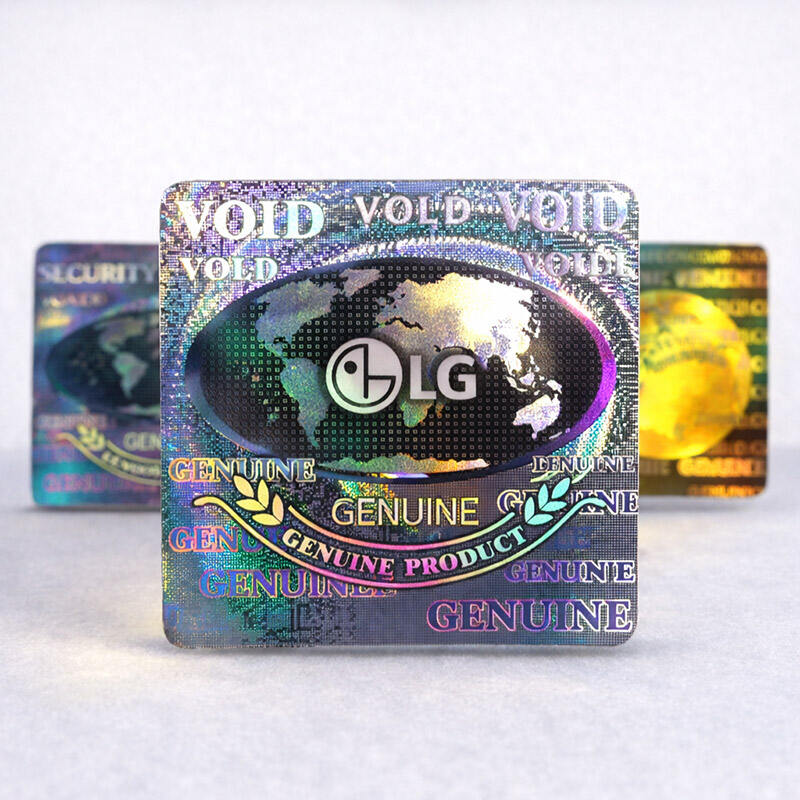
Authentic hologram stickers generate genuine three-dimensional depth through precise light diffraction—making images appear suspended beneath the surface. When tilted, they exhibit true parallax: foreground and background elements shift independently, mimicking natural depth perception. Counterfeits rely on iridescent foils that produce only a flat, static rainbow sheen—no dimensional separation. As confirmed by the Authentication Journal (2023), 78% of forged holograms fail basic parallax verification. To test, rotate the sticker slowly while observing from eye level: authentic versions reveal layered spatial relationships; fakes remain monodimensional.
Dynamic Color-Shifting and Angle-Dependent Image Transitions
True holograms deliver sophisticated, nanoscale optical transitions—not just hue shifts, but full compositional changes. As viewing angle changes, colors morph fluidly (e.g., blue to gold), and entire image elements transform: a logo may dissolve into microtext, reveal hidden graphics, or animate subtle motion effects. This is enabled by proprietary embossed diffraction gratings—not pigment-based inks. Industry testing shows authentic stickers achieve 12+ distinct, high-fidelity image transitions across a 180° rotation; counterfeits average only 2–3 static color variations with no structural evolution.
High-Resolution Rendering and Accurate Color Fidelity Under White Light
Under neutral white light, genuine holograms maintain crisp detail and brand-accurate color without pixelation, bleeding, or moiré distortion. At 10x magnification, continuous-tone imagery remains sharp—even text as small as 0.2mm stays legible. Counterfeits often show visible grain, tone shifting, or chromatic fringing under identical conditions. Verified authentic stickers preserve Pantone-matched colors within ΔE < 2 (Color Science Institute, 2023), reflecting mastering precision exceeding 1,500 lines/mm—a resolution unattainable with standard printing or foil stamping.
| Authentication Marker | Authentic Hologram | Counterfeit Indicator |
|---|---|---|
| 3D Depth Perception | Multi-layered parallax | Flat iridescent sheen |
| Image Transitions | 8–15 angle-dependent shifts | ≤3 static color changes |
| Color Accuracy | ΔE<2 variance under white light | Visible tone shifting/bleeding |
Tamper Evidence: Reliable Anti-Counterfeiting Indicators in a Hologram Sticker
Destructive Delamination: Irreversible Fragmentation Upon Removal
High-security hologram stickers are engineered with brittle polyester films and high-tack adhesives that bond permanently to the substrate. Attempted removal triggers irreversible delamination—the holographic layer fractures into confetti-like fragments, rendering reuse impossible. This self-destructive architecture leaves unmistakable forensic evidence of tampering and is widely adopted in pharmaceuticals, electronics, and luxury goods where package integrity directly impacts safety and trust.
Adhesive Void Patterns: Visible ‘VOID’ or Custom Text Left on Surface After Peeling
Premium holograms use chemically tuned adhesives that transfer pre-engineered negative patterns onto the applied surface during removal. These appear instantly as positive “VOID” text, honeycomb grids, or brand-specific warnings—visible without magnification. The transfer relies on an irreversible chemical interaction between adhesive and substrate, preventing replication or erasure. Unlike simple residue, these void markers serve as dual-evidence indicators: they appear both on the removed sticker and the underlying surface, confirming unauthorized access.
| Feature | Mechanism | Tamper Evidence |
|---|---|---|
| Destructive Delamination | Layer fragmentation | Permanent hologram destruction |
| Adhesive Void Patterns | Pattern transfer | Surface residue with VOID/custom text |
Manufacturing Precision: Microscopic and Structural Quality Markers
Crisp Microtext, Nanotext, or Embedded Security Icons Under 10x Magnification
Under 10x magnification, authentic holograms reveal security features that expose counterfeit limitations: legible microtext below 0.2mm, nanoscale patterns forming covert images, and precisely embedded icons like hidden logos or serial markers. These require laser interference lithography and nano-imprinting—technologies inaccessible to mass-printing operations. A 2024 study in the Optical Security Journal found 92% of counterfeit holograms failed microscopic verification due to blurring, inconsistent line width, or missing layers.
Flawless Die-Cut Edges and Perfect Alignment Between Hologram Layer and Substrate
Structural integrity is visible at a glance: premium holograms feature razor-sharp die-cut edges with zero fraying, seamless fusion between holographic foil and adhesive backing, and pixel-perfect registration across all layers. Precision cutting systems operate at tolerances under 5 microns; misalignment exceeding 0.3mm strongly indicates compromised tooling or process control. Top-tier manufacturers employ vision-guided placement systems to ensure layer coherence—essential not only for aesthetics but for reliable tamper response.
FAQ
What is the main purpose of a hologram sticker?
The main purpose of a hologram sticker is to provide a secure, anti-counterfeit solution through complex optical effects that are difficult to replicate. They offer visual authenticity checks and tamper-evident features.
How can you differentiate between an authentic and a counterfeit hologram?
Authentic holograms exhibit true 3D depth perception with parallax, dynamic color-shifting, and nano-scale image transitions. In contrast, counterfeits often display flat, static rainbow sheens with limited color variations.
What tamper-evidence features should be present in a quality hologram sticker?
Quality hologram stickers feature destructive delamination and adhesive void patterns that leave evident residue and fragmentation upon attempted removal, signifying tampering.